The Nanyang Chronicle: Then and now
Readers of the Nanyang Chronicle can look forward to new articles and a limited print edition next semester.
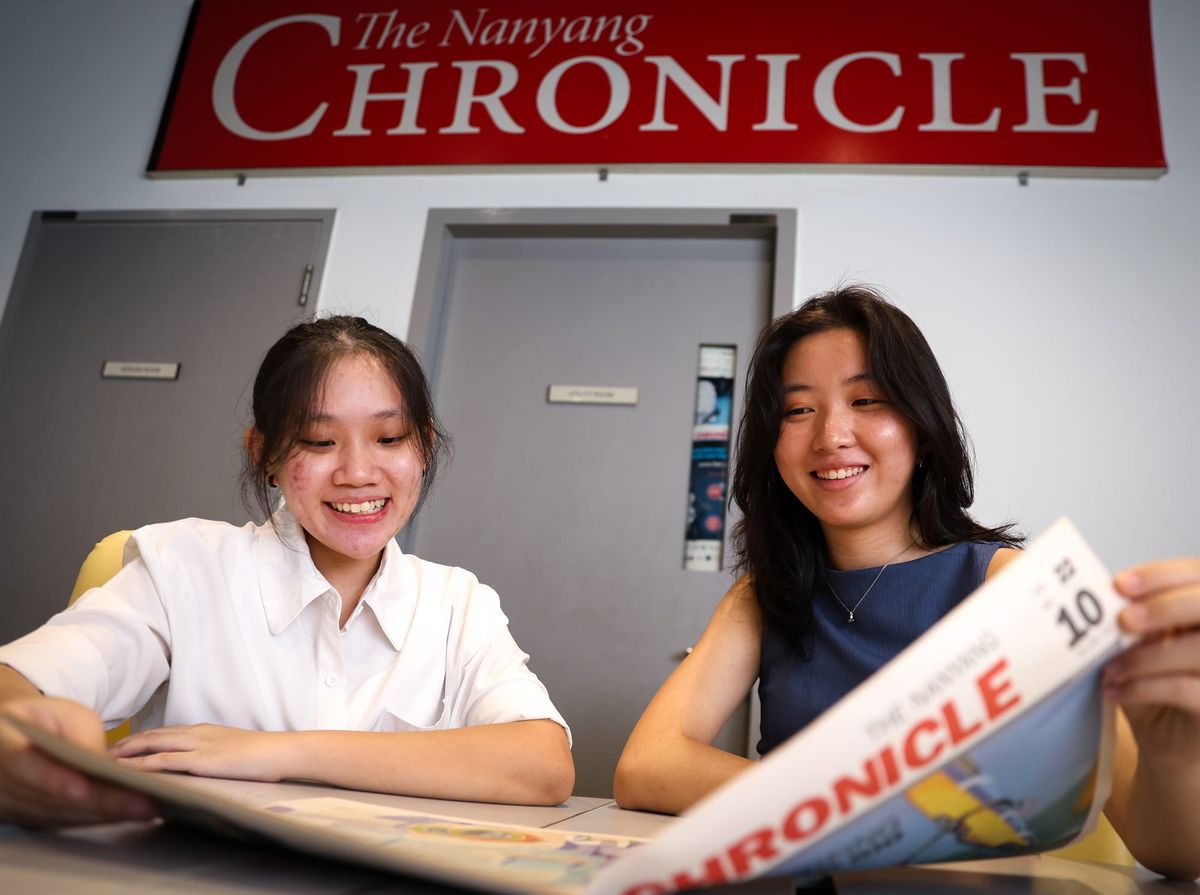
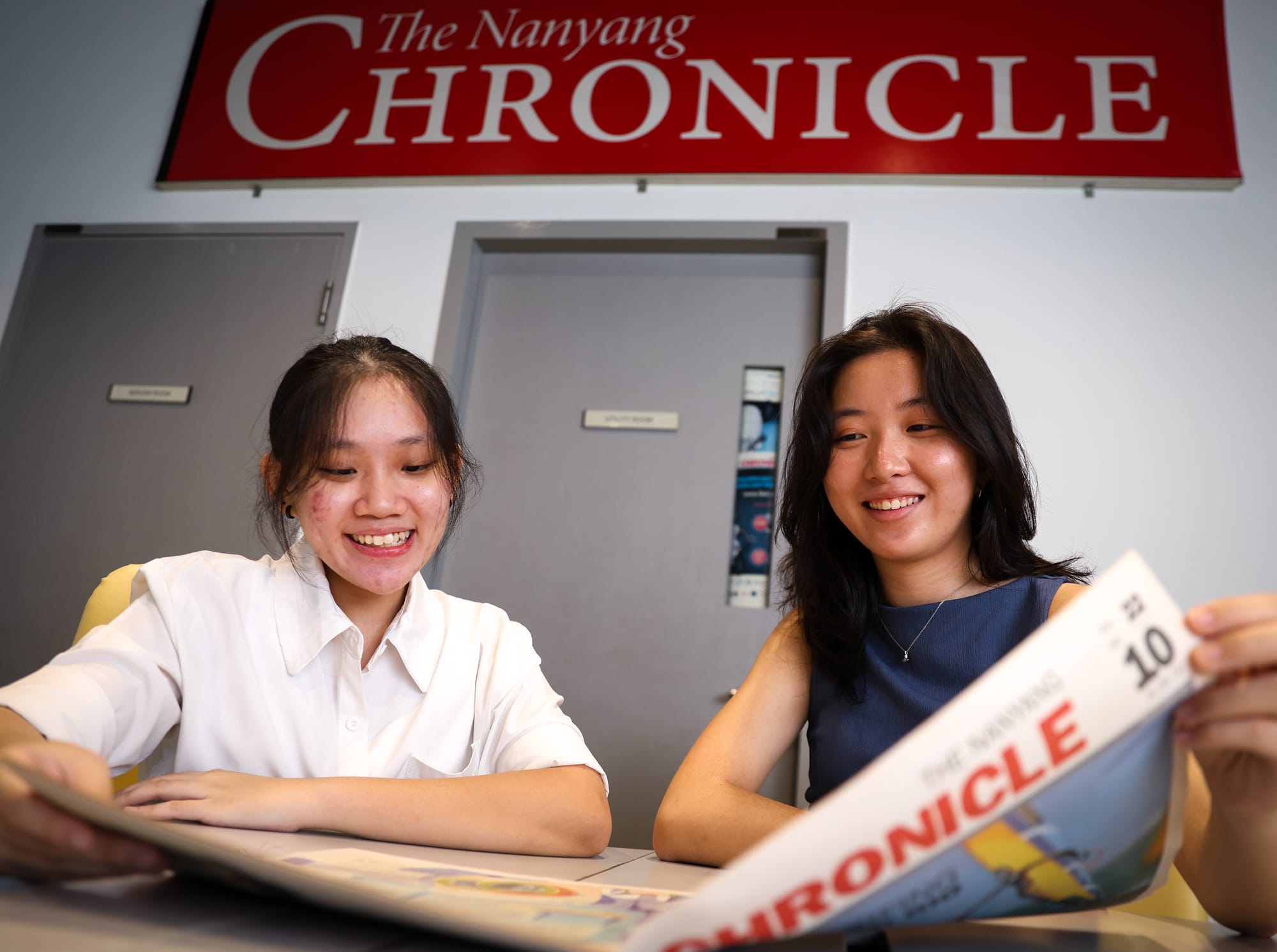
SINGAPORE — NTU's campus publication, the Nanyang Chronicle, has returned after a six-year break.
On April 11, the Chronicle published a series of six articles written by a small group of students from the Wee Kim Wee School of Communication and Information (WKWSCI). The articles covered a variety of topics, from dating app fatigue to concerns over NTU’s halal food variety.
Darren Ang, 22, a first-year student at WKWSCI, interviewed students and aspiring start-ups about the renaming of The Hive to UOB Innovation Hub.
“There were strong reactions with regard to how people felt about the name change,” he said, “I (wanted) to show two sides of that coin — the school’s perspective and those who feel strongly against it.”
In the coming semester, the Chronicle will be expanding its team to an estimated 30 reporters, photographers and designers. From September, stories covering NTU events, campus happenings and student concerns will be published weekly.
A chronicled history
The Chronicle started in July 1994 as an extracurricular club.
Mr Tan Kim Lian, 68, recounts being approached by the late Professor Eddie Kuo, founding dean of WKWSCI. Mr Tan had joined the school as a visiting fellow and was tasked by Prof Kuo to establish the print journalism and publishing division in the school, which included setting up a school newspaper.
“You have a school of communication studies and research; it really begs for you to have a vehicle that can both train and showcase your students’ abilities. The campus newspaper would serve as this vehicle,” Mr Tan said. He is now an assistant news editor at the Boston Globe.
The Chronicle was where chief photojournalist of the Straits Times, Mr Kevin Lim, 44, first picked up photography. He contributed to the paper as a photo editor and photographer from 2005 to 2006.
“I tell everybody I am where I am today because I joined the Nanyang Chronicle,” he said.
He recalls being assigned to photograph Scottish rock band Franz Ferdinand’s concert for the Chronicle.
“As a poor student, concerts were a luxury,” he shared, “It was a perk, even if it meant only shooting the first three songs.”
In the mid-2010s, the Chronicle became a practicum module offered by WKWSCI to hone students’ journalistic and editorial skills.
The paper acted as a formative training ground for many aspiring journalists, many of whom are prominent figures in both the local and global media industry today. Some alumni include senior editor at Bloomberg News and former Asia finance editor at the Wall Street Journal Serena Ng, editorial director of AI at Hearst Newspapers Derrick Ho, and Singaporean actress and singer Michelle Saram.
Widespread influence
The Chronicle became an integral part of student life, making waves both on campus and in Singapore.
Many articles written for the Chronicle were picked up by local media outlets over the years. Some examples include stories on student-initiated group chats to help clear leftovers at buffets around campus, beer brewing activities in halls, and juggling university life with fatherhood.
In particular, the Chronicle was quoted by multiple publications in 2016 on their report of a peeping Tom in Hall 16.
The Chronicle reported that the victim witnessed a smartphone above the cubicle wall while he was showering and subsequently attempted to confront the suspect. Later, 66 videos of male students showering were found in the recently deleted folder of the suspect’s phone. These findings were quoted by the Straits Times, Stomp and Yahoo News Singapore.

The Chronicle’s fashion column, Dapper, creatively explored various style trends and topics — from the minimalist look to plus-sized fashion for men. The Dapper pages even featured local celebrities and influencers, including names like Benjamin Kheng and Mongchin Yeoh.
The Chronicle also functioned as a vessel for student voices.
BBC News journalist, Mr Osmond Chia, 30, used to write for the Chronicle back when he was a student at WKWSCI. He recalls once reporting on incidents of birds colliding with glass buildings on campus.
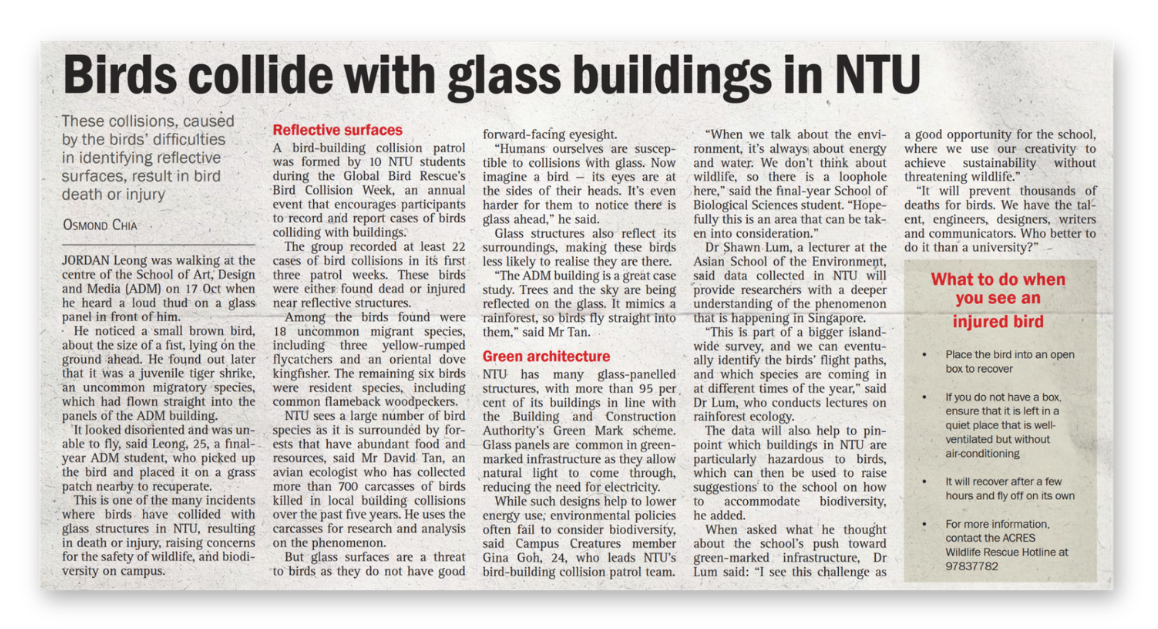
A student had approached him about the sightings and expressed the desire to raise awareness. To collect information for his article, Mr Chia followed concerned students in the wee hours of the morning to sweep the School of Art, Design and Media building for cases of bird collisions.
In 2008, the paper found itself at the centre of a controversy when university administration instructed students not to print a report on Singapore Democratic Party secretary-general Chee Soon Juan’s visit to NTU.
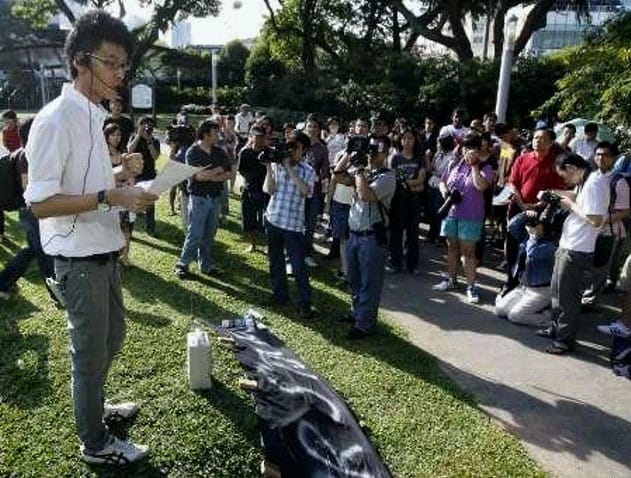
This sparked a series of events: A group of students organised a demonstration at Hong Lim Park where they protested against the lack of editorial independence on campus, and some students set up a now-defunct independent online newspaper, The Enquirer, according to the Straits Times.
End of an era
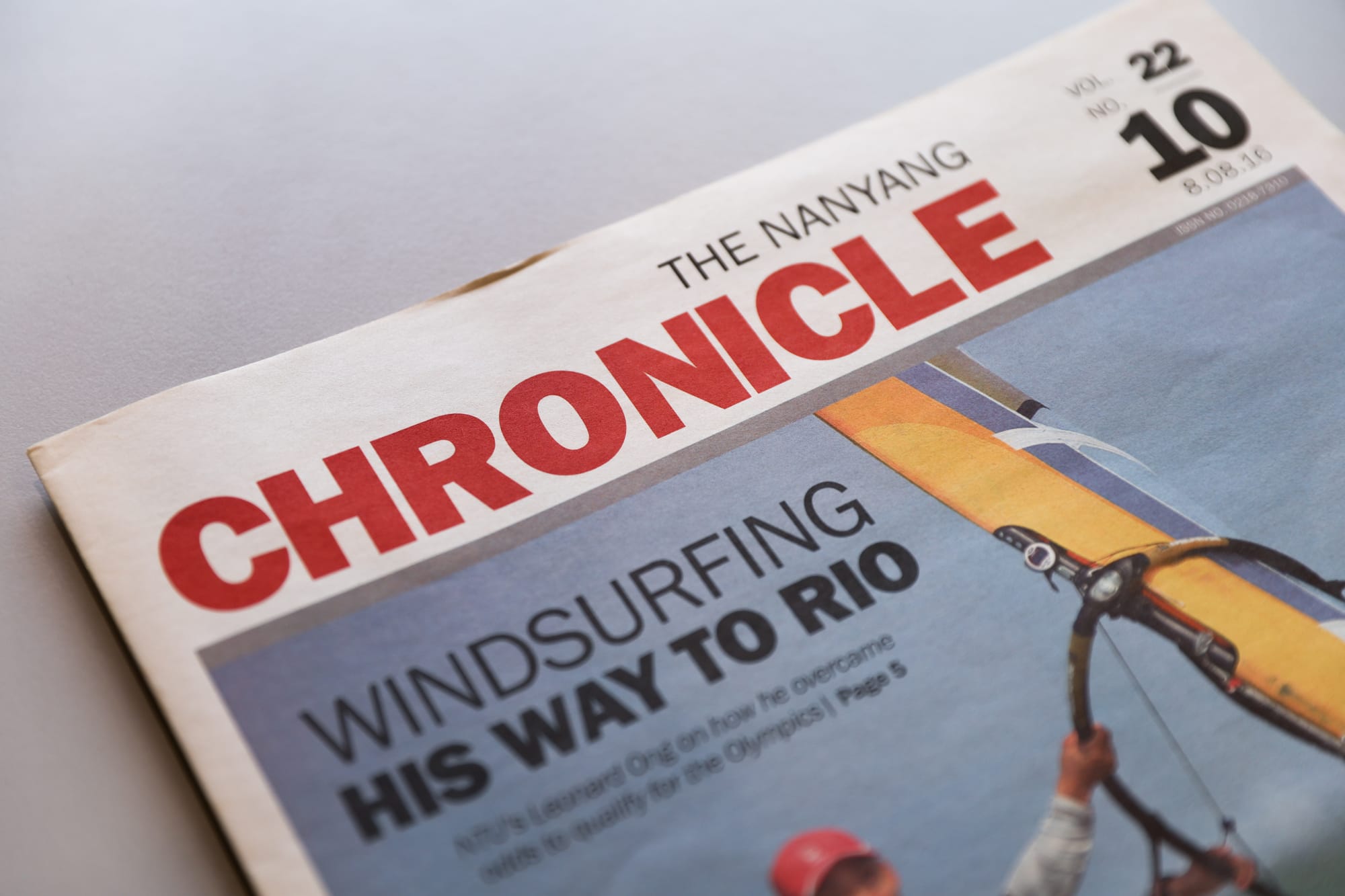
However, in 2019, the Chronicle stopped its print run and was no longer offered as a module for students.
Mr Chia and Mr Matthew Loh, 29, now a senior reporter at Business Insider, were part of the Chronicle team in 2018 right before the paper halted publication. Soon after, the duo co-founded their own student-run publication, Soapbox.sg.
Mr Chia said that after the Chronicle went on hiatus, there were no outlets for interested students to write unless they pursued external opportunities.
From wildlife sightings to increments in campus housing rents, Soapbox reported on various happenings in NTU. In particular, a story on an NTU Students’ Union presidential candidate who was accused by a younger union officer of tricking her into getting drunk gained much traction. It was subsequently picked up by local media outlets including the Straits Times and CNA.
“You know, what is a journalism school without a journalism interest group?” Mr Chia said, “There are so many stories that can be told from school.”
The future
When Chair of WKWSCI Professor Jack Qiu, 53, heard that a couple of students were interested in bringing back the Chronicle, he was very excited. He shared that many alumni of WKWSCI expressed similar enthusiasm.
He called attention to the late Mr Wee Kim Wee, whom WKWSCI is named after. Before serving as the fourth President of Singapore, Mr Wee was a journalist at the Straits Times and the United Press Association.
“Journalism itself globally (is) facing challenges,” he said, “Many things are changing. However, one thing that is not changing is our school’s name.”
In addition to the regular slew of articles published on the Chronicle’s website, the team will be publishing a limited print edition in the latter half of the year.
The print will feature a broader range of stories that concern issues beyond the NTU campus.
Assistant Professor at WKWSCI and Chronicle faculty supervisor Lydia Cheng said that the success of the paper should be measured by the extent that students are mentored and their subsequent ability to pursue their desired careers after graduation.
“The numbers, the viewership, that to me is not really the end goal,” she said, “It is the process that the students get… the long nights where they have to rewrite their stories, that process to me is where I find fulfilment."
Prof Cheng was a former editor of the Chronicle’s fashion pages, Dapper, from 2014 to 2015.
Prof Qiu described the “freedom” that comes with journalism — the different people you speak to and the different questions you ask them.
“All of (these…) are human decisions, and there are endless possibilities for you to configure and reconfigure,” he said, “And so that is a very creative job, while you also stay true to the truth that you are trying to uncover.”
The Nanyang Chronicle recruits NTU students in June and December of each year for roles across writing, photography, video, design and illustration. Interested students can look out for recruitment announcements during those periods.