Zero swiping for smarter matches: Can campus-specific indie matchmaking platforms counter dating app fatigue for NTU students?
Emerging indie student-run matchmaking platforms are challenging traditional online dating norms by offering more personalised and efficient ways to date.
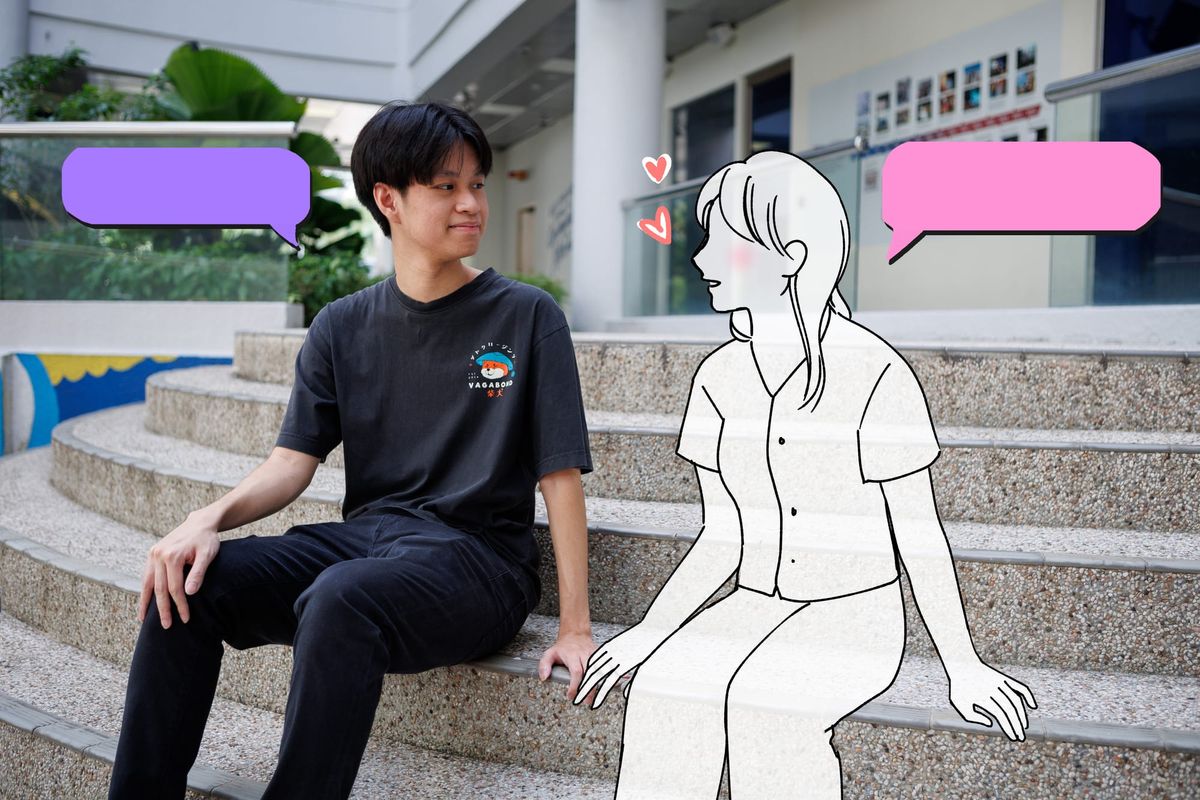
When 22-year-old communication studies freshman Tan Zi Rui signed up for matchmaking platform Aphrodite Project in September last year, it was merely a curious venture into the world of online dating.
Zi Rui, who had never been in a relationship before, had to trawl though 70 personal questions in an online form – ranging from his hobbies, relationship deal breakers and “would you rather” hypotheticals – before being matched with a compatible partner.
Melody (not her real name), 21, a second-year STEM – science, technology, engineering and mathematics – student in NTU who matched with Zi Rui had been the one to text first. What started as sharing common interests over Telegram stretched into unassuming late-night conversations that crept past midnight – even as Melody chose not to share a photo of herself.
Still, a month later, the pair arranged for a first date.
The neon lights of Clarke Quay shimmered across the water as Zi Rui spotted her — a girl in a blue dress walking towards him. He didn't know what she looked like until that moment. A month earlier, he hadn't even known her name.
What he did know was that she shared his hobbies of running, travelling and gaming, and that she had also survived the same gruelling 70-question form.
Six months later, Melody agreed to be his first-ever girlfriend.
The science of matchmaking
The Aphrodite Project, which sees over 1,000 sign-ups among NTU students annually, is an “indie” campus-centric matchmaking platform. It was launched in 2019 by a National University of Singapore student, and applications open in September every year.
“The idea was: why don't you try and do it empirically, using psychology and whatever we know from economics, to try and match people well?” said founder Mr Aiden Low, 29.
It is among other indie student-run matchmaking platforms challenging traditional online dating norms by offering more personalised and efficient ways to date within campuses.
Some NTU students prefer using online platforms to meet fellow students over dating organically on campus to separate love and school.
Second-year medicine student Gavin Tay, 21, who also tried the Aphrodite Project, said, “I don’t want the conversation to be confined to my course, (I wanted) something more holistic."
Samantha Lim, 20, was among NTU students who signed up for the AI Telegram bot Rende. The second-year business student first heard about it from a friend.
For over a year during her junior college days, Samantha had been using dating apps like Hinge intermittently but grew tired of yielding only short-lived relationships and “situationships”.
Now, instead of swiping through different profiles like she did on Hinge, Samantha answered 10 questions on Rende’s Telegram bot and created her private profile that would only be seen by an AI agent to simulate matches.
Every Tuesday, she would receive a new match revealing their photo, along with an AI-driven explanation of her compatibility with the match. Users may or may not receive weekly matches depending on compatibility with the dating pool, and a feature to stop running new matches has not been rolled out yet.
To date, Samantha has met two of her matches, with a third date planned with her second match.
The business student went on her first date with her second match at Connect71 Cafe in NTU after the bot had suggested the spot and asked if she wanted to “accept it and schedule a date”.
“We had very natural and engaging conversations during the date. We were quite similar as individuals and shared similar interests and overall vibe,” Samantha said.
“The date extended beyond the cafe, and we spent more time together at my hall afterwards. We continued texting on Telegram throughout the week until our next date,” she added.
For dates, Rende also offers icebreaker question prompts tailored to the match, which Samantha found helpful. She noted that it made starting conversations easier and reassured her during the date.
“He was also my type and did not give off any uncomfortable vibes, unlike some of the people I have met through dating apps,” Samantha said.
“When using Hinge previously, I had to manually filter profiles and put effort into conversations before even meeting. In many cases, conversations would fade before a date happened, and managing multiple chats at once could be tiring.”
Samantha added that Rende’s campus-centric function allowed her to meet other NTU students to date, whereas traditional dating apps do not offer a school-centric dating pool.
“Since I stay in the hall, meeting others in similar environments is important to me, and Rende supports that well,” she shared.
Paving the way

Rende follows predecessors like Not A Dating App (NADA) and Project Kaya launched in 2021 and 2024 respectively, though both have since stopped running.
Nanyang Business School alumnus Mr Keith Tan, who founded Rende, said that he created the bot to fix the issue of “endless conversations” on dating apps: the campus-centric bot does away with swiping and keeps dating profiles private unlike traditional dating apps.
“Here, you just answer naturally, and the AI handles the rest. From profile creation to matchmaking to explanations, the AI curates your profile and identifies patterns,” he said, adding that this was different from dating apps that use a scoring algorithm.
Students also need to sign up with their school emails to verify their student identities for safety, Mr Tan added.
“A feature in our pipeline will even plan the date after a match. For example, since we know you are in NTU and both of you like going to cafes on the weekend, we can suggest a meetup at Connect71 cafe at North Spine,” he added.
To test if algorithmic matches translate to in-person chemistry, Rende is hosting a singles mixer for NTU students on Apr 20 held at a location only known to those who have registered. Currently, there is a waitlist, with over 40 student sign-ups so far.
Rise of agentic-AI matchmaking platforms
Across the world, AI matchmaking platforms are slowly making their mark. In London, Fate, which brands itself as the first "agentic AI dating app", launched last May — users "onboard" via an interview with an AI personality before they are presented with five potential matches. Other start-ups, such as Sitch and Keeper, launched in the United States, use AI to learn large amounts of information about the user to find more personalised matches for them.
The rise of Telegram bots
Meanwhile, Telegram matchmaking bots such as Cupid SG Bot, NTU Match Bot and NTUMatch’A Friend have also emerged in recent years.
These bots allow users to set up their profile by typing a command such as “/setup”, before moving to details like gender, year of study, major and even Myers-Briggs Type Indicator type. Users can also verify their profiles with their student emails.
They can then filter their matches by selecting corresponding preferences such as year of study, major and requiring their match to be a verified student before starting the matching process.
Third-year medicine student Hozea Tong, 26, has been on NTU Match Bot and other Telegram bots for about a year, not only hoping to meet a potential partner but also to make new friends. Despite facing matches who end chats before conversation, he remains optimistic.
“I guess there’s no harm to keep trying. Some are kind enough to exchange contact details and remain in contact,” he said.
Can an algorithm predict chemistry?
For AI-driven platforms like Rende, NTU Interdisciplinary Collaboration Core (ICC) professor Jeremy Sng warned that offloading pre-date chatting to AI may lead to people meeting someone they have less chemistry with.
“People might ignore red flags or settle because they trust the ‘objective’ math of the AI more than their own intuition or feelings,” said Dr Sng, whose research focuses on psychological and behavioural outcomes of media use.
He attributed this to the self-fulfilling prophecy – where people may invest less effort into interactions if AI already has already rejected their compatibility with someone – leading to a “subpar” outcome.

School of Art, Design and Media freshman Anastasia Tan, 24, who met her boyfriend on dating app OkCupid, said she would not use platforms like the Aphrodite Project due to the lack of profile photos and not wanting the platform to choose her match.
“I care about how someone looks or presents themselves... I don't want someone to do the choosing for me,” she said.
Samantha, who feels hopeful about her second match from Rende, felt that was not only “her type” but was different from other men she met, including her previous partners.
“There was a strong sense of certainty, where it felt like a ‘when you know, you know’ situation,” Samantha said.
“I will see how things progress, but my goal has always been to eventually enter a relationship.”